
Every hit, yours or a creature's, goes through the same steps in the same order. The order matters: a flat bonus added late is not multiplied by anything, and a multiplier early on multiplies everything after it.
Damage types
There are six: Slash, Pierce and Bludgeon, which are physical, and Heat, Cold and Energy. Each attack deals one type, set by the attack itself. A weapon lists a number for every type it can deal, and the attack's type picks which number counts. A 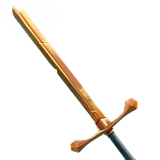 Copper Sword has some of all three physical types, so its slashes and its thrusts hit a little differently.
Slash, Pierce and Bludgeon also come in melee and ranged versions. That decides which of your skills scales the hit.
A hit, step by step
- Base damage. Every attacker starts with 1 point of base damage, before anything else.
- Typed damage. Your total damage of the attack's type is added, after the target's resistance to that type has taken its share (see resistance). A target that is vulnerable to the type takes more.
- Your skill, then theirs. The running total is multiplied by your Strength (melee), Ranged (ranged) or Sorcery (Heat, Cold and Energy), and then by the target's Defense. See your levels.
- The attack. Multiplied by the attack's damage percentage. Each ability lists its own.
- Light and heavy bonuses. Gear and effects can raise light or heavy attacks separately. Without them this step does nothing.
- Critical hit. If you have any critical chance, a critical multiplies the hit by 1.5 (more with the right gear).
- Global bonuses. Your general damage bonus, then the target's general damage reduction.
- Faction bonus. Extra damage against one family of foes, if you have it.
- Family bonus from affixes. Some item affixes add flat damage against a family. It is added here, after every multiplier.
- Armor. Flat armor is taken off the total. It cannot take the hit below zero.
- Block or parry. If you are blocking, part of what is left is stopped. See blocking and parrying.
What remains is rounded down to a whole number and taken from the target's health. A hit worth 7.9 does 7.
Two things surprise people. First, resistance only works on the typed damage in step 2. The base point from step 1 gets through untouched. Second, the armor in step 10 is a flat stat that comes from effects and item modifiers. The armor you wear gives resistances, which work in step 2.
Resistance
Resistance does not subtract. Each point removes about 1.7% of the typed damage that is still left, so it never quite reaches zero. Forty points halve a hit; a hundred leave less than a fifth.
| Resistance | Typed damage taken | Blocked by resistance |
|---|---|---|
| 0 | 100% | 0% |
| 5 | 91.8% | 8.24% |
| 10 | 84.2% | 15.8% |
| 15 | 77.3% | 22.7% |
| 20 | 70.9% | 29.1% |
| 30 | 59.7% | 40.3% |
| 40 | 50.3% | 49.7% |
| 50 | 42.3% | 57.7% |
| 60 | 35.6% | 64.4% |
| 80 | 25.3% | 74.7% |
| 100 | 17.9% | 82.1% |
| 125 | 11.6% | 88.4% |
| 150 | 7.58% | 92.4% |
Negative resistance, from a debuff for example, makes the target take more than the full amount.
Your levels
Your level in the attacking skill is turned into a combat rating that grows fast early and flattens out later: 150 x (1 - e-0.011 x level). Each rating point adds 2% to your damage and takes 1% off the damage a defender with that Defense rating receives. Boosts count, because the rating uses your effective level.
| Level | Combat rating | Your damage (Strength, Ranged, Sorcery) | Damage you take (Defense) |
|---|---|---|---|
| 1 | 1.6 | x1.03 | 98.4% |
| 5 | 8.0 | x1.16 | 92% |
| 10 | 15.6 | x1.31 | 84.4% |
| 15 | 22.8 | x1.46 | 77.2% |
| 20 | 29.6 | x1.59 | 70.4% |
| 25 | 36.1 | x1.72 | 63.9% |
| 30 | 42.2 | x1.84 | 57.8% |
| 40 | 53.4 | x2.07 | 46.6% |
| 50 | 63.5 | x2.27 | 36.5% |
| 60 | 72.5 | x2.45 | 27.5% |
| 70 | 80.5 | x2.61 | 19.5% |
| 80 | 87.8 | x2.76 | 12.2% |
| 90 | 94.3 | x2.89 | 5.74% |
| 100 | 100.1 | x3.00 | 0% |
The Defense column falls to nothing at level 100, where the rating passes 100.
What each weapon trains
Hitting something trains the skills of the weapon in your main hand, not the skill that scales the damage. A sword trains Dexterity, yet melee damage scales with Strength. Sorcery abilities always train Sorcery, whatever you hold.
| Weapon type | Trains | For example |
|---|---|---|
| Sword | Dexterity | Copper Sword,  Iron Sword, Iron Sword,  Steel Sword Steel Sword |
| Spear | Dexterity |  Copper Spear, Copper Spear, 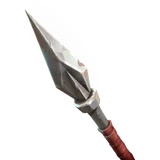 Iron Spear, Iron Spear, 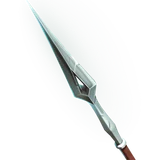 Steel Spear Steel Spear |
| Greatsword | Strength and Dexterity, half each | 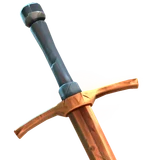 Copper Greatsword, Copper Greatsword, 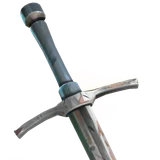 Iron Greatsword, Iron Greatsword, 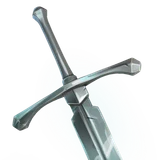 Steel Greatsword Steel Greatsword |
| Mace | Strength | 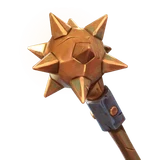 Copper Mace, Copper Mace, 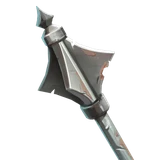 Iron Mace, Iron Mace, 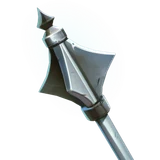 Steel Mace Steel Mace |
| Axe | Strength | 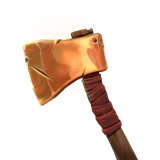 Copper Axe, Copper Axe, 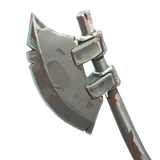 Iron Axe, Iron Axe, 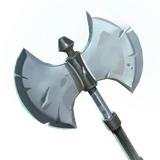 Steel Axe Steel Axe |
| Pickaxe | Strength | 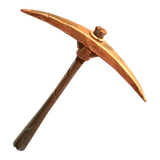 Copper Pickaxe, Copper Pickaxe, 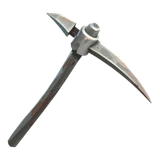 Iron Pickaxe, Iron Pickaxe, 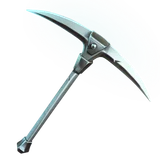 Steel Pickaxe Steel Pickaxe |
| Bow | Ranged and Dexterity, half each | 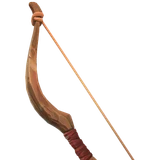 Poplar Shortbow, Poplar Shortbow,  Willow Shortbow, Spruce Shortbow Willow Shortbow, Spruce Shortbow |
| Crossbow | Ranged | 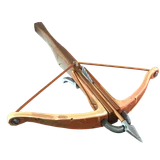 Copper Crossbow, Iron Crossbow, Steel Crossbow Copper Crossbow, Iron Crossbow, Steel Crossbow |
| Throwing Axe | Ranged and Strength, half each | No weapon has this type in the game data yet |
| Staff | Sorcery | 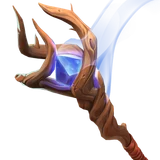 Poplar Staff, Cold Battlestaff, Heat Battlestaff Poplar Staff, Cold Battlestaff, Heat Battlestaff |
| Wand | Sorcery | 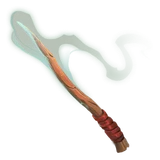 Poplar Wand Poplar Wand |
You earn 1.8 experience for each point of damage you deal, split evenly between the listed skills. A greatsword hit for 10 gives 9 Strength and 9 Dexterity.
Critical hits
Nobody starts with critical chance. It comes from item modifiers and effects. When a hit crits, it is multiplied by your critical damage multiplier, which is 1.5 unless something raises it. The roll happens after your skill and the attack's percentage, so a crit multiplies all of that.
Faction bonuses
Some modifiers and effects give extra damage against one family: Humans, Bandits, Thrunk, Birds, Farm Animals, Bovines, Zombies, Skeletons, Spiders, Demons, Wolves, Spot Caps, Deep Caps or Players. The bonus multiplies the whole hit up to that point. Occultists are a faction of their own, and nothing gives a bonus against them.
Player against player
Players only hurt each other on worlds where PvP is switched on. Elsewhere a player's attack on another player deals nothing.
Staggers and knockback
A light attack makes its target flinch for a quarter of a second, with no knockback. A heavy attack staggers and pushes, depending on the size of whatever it hits. Players count as medium.
| Target size | Stagger | Knockback |
|---|---|---|
| Tiny | 0.5s | 3 m |
| Small | 0.4s | 2 m |
| Medium | 0.3s | 1.25 m |
| Large | 0.25s | 0.5 m |
| Giant | 0.25s | None |
Blocked hits, hits that do no damage and damage over time never stagger. If the target is winding up an attack of its own, your hit only interrupts it some of the time: 60%, plus 20% for each size you are bigger than it (less 20% for each size smaller), plus 20% if yours is a heavy attack, minus 20% if its wind-up is a heavy attack.